
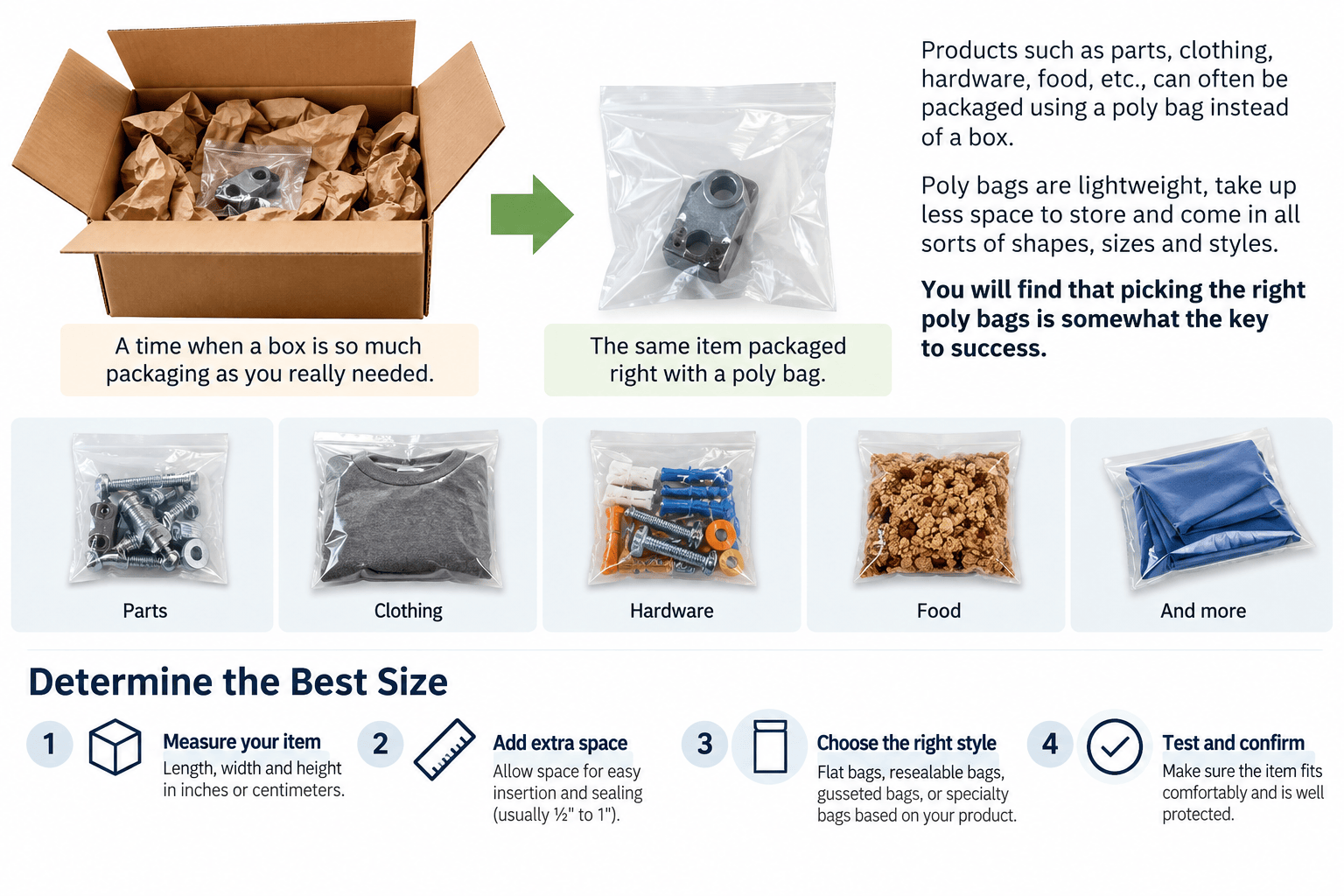
A time when a box is so much packaging as you really needed.
Products such as parts, clothing, hardware, food etc., can often be packaged by using a poly bag instead of a box. Poly bags are lightweight; take up less space to store and come in all sorts of shapes, sizes and styles.
You will find that picking the right poly bags is somewhat the key to success.
Determine the best size

When you purchase a poly bag, you should look at the size of the poly bag compared to the item you will be placing into it.
If the bag is too small, it can be difficult to get the product into the bag or sometimes even close it. Conversely, if you buy a poly bag that is far too big, you end up wasting more plastic than necessary.
Measure the item before buying bags
Before purchasing a poly bag, determine the exact measurements of the item(s) you intend to package.
Consider the thickness of the item
In addition to determining the proper size of the poly bag (length x width), you also need to determine whether or not the product you are packaging requires a specific thickness of poly bag.
For example, thin poly bags are ideal for use with light-weighted products without sharp edges. Thicker poly bags would be recommended for heavier products which are likely to cause damage to the bag during storage, shipment, or unpacking.
Select the proper closure type for the product
Poly bags can also vary in terms of their closure types. Some poly bags have an open-top design. Depending upon the product, these bags can then be sealed using various methods including: tape, ties, staples, and/or heat sealers.
Other types of poly bags include those that contain a zipper-type closure that allows the customer to reseal the bag after opening it. Examples of products that lend themselves well to this type of closure include small parts, hardware, craft supplies, etc. This style of closure provides additional security against unauthorized access to the contents of the bag.
Self-sealing poly bags provide an added benefit over resealable poly bags. Self- sealing poly bags eliminate the need to physically close the top of the bag prior to sealing. In turn, this speeds up the overall process of packaging.
Protect products from environmental elements
Protection does not necessarily equate to preventing a product from breaking. Sometimes, the main reason for utilizing a protective covering like a poly bag is to prevent environmental elements from damaging the product.
Examples of environmental elements that can potentially damage your product include dust, dirt, and moisture. By placing your product within a clear poly bag, you will create a simple barrier between your product and potential contaminants. At the same time, you will still allow customers to view what is contained within the bag. As such, poly bags are used for both storing and shipping products.
Match the correct poly bag to the product and process
Just like there is no perfect poly bag that fits every product and application, similarly, there is no single “best” way to pack most products. Each product and process requires consideration based upon factors such as: product size/weight/shapes/type; how the bag needs to be closed; and how much protection is required for each product.